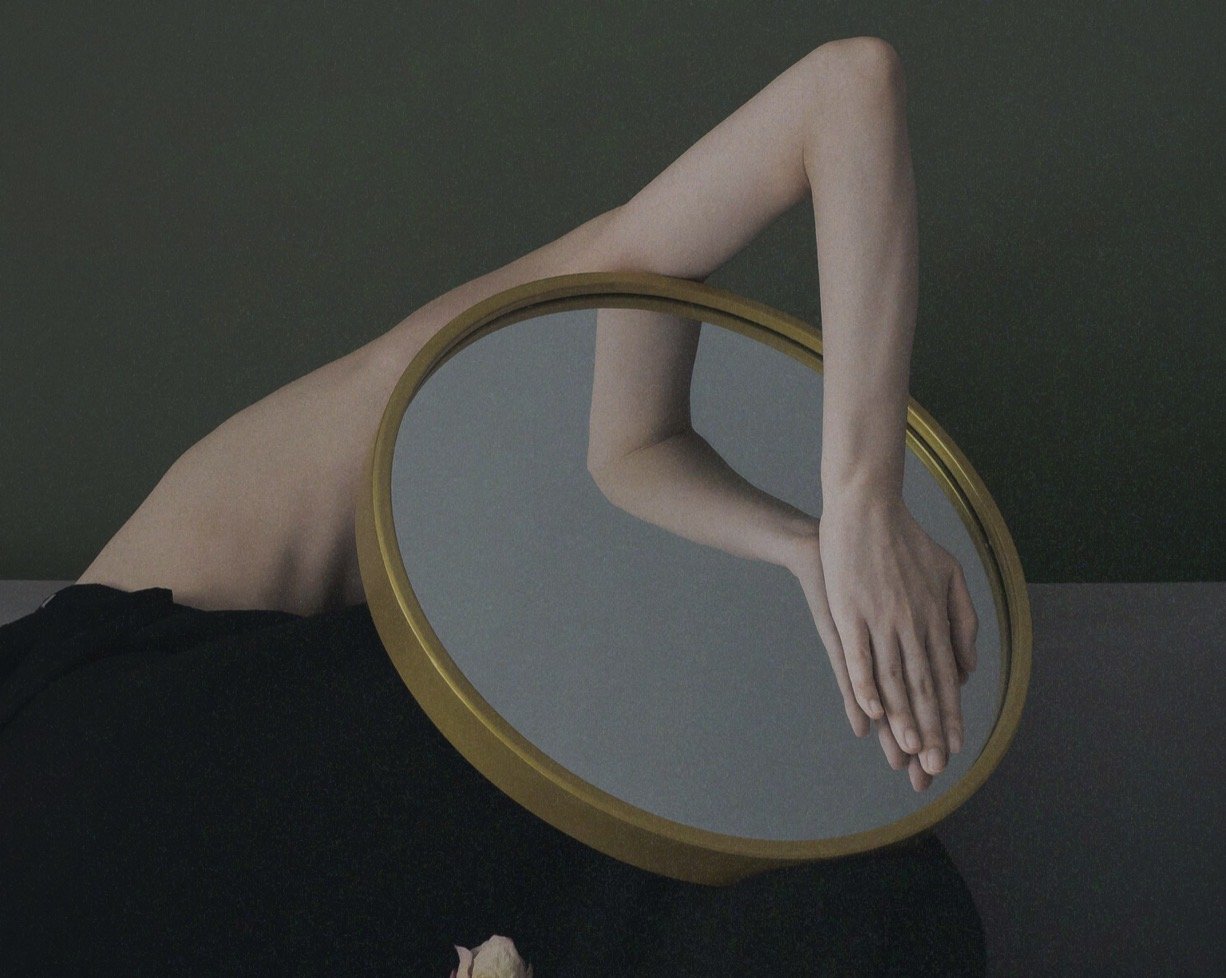
There is a difference between looking at yourself and truly seeing yourself. A mirror does more than reflect—it composes.
Most of us use the mirror transactionally. We check, adjust, correct, and move on. It confirms readiness before we step out into the world. But it can serve a different purpose.
The mirror can become a space for examination, a private gallery in which you are both subject and observer. When approached without urgency or the impulse to improve, it can resemble portraiture. Instead of fixing yourself, you frame yourself.
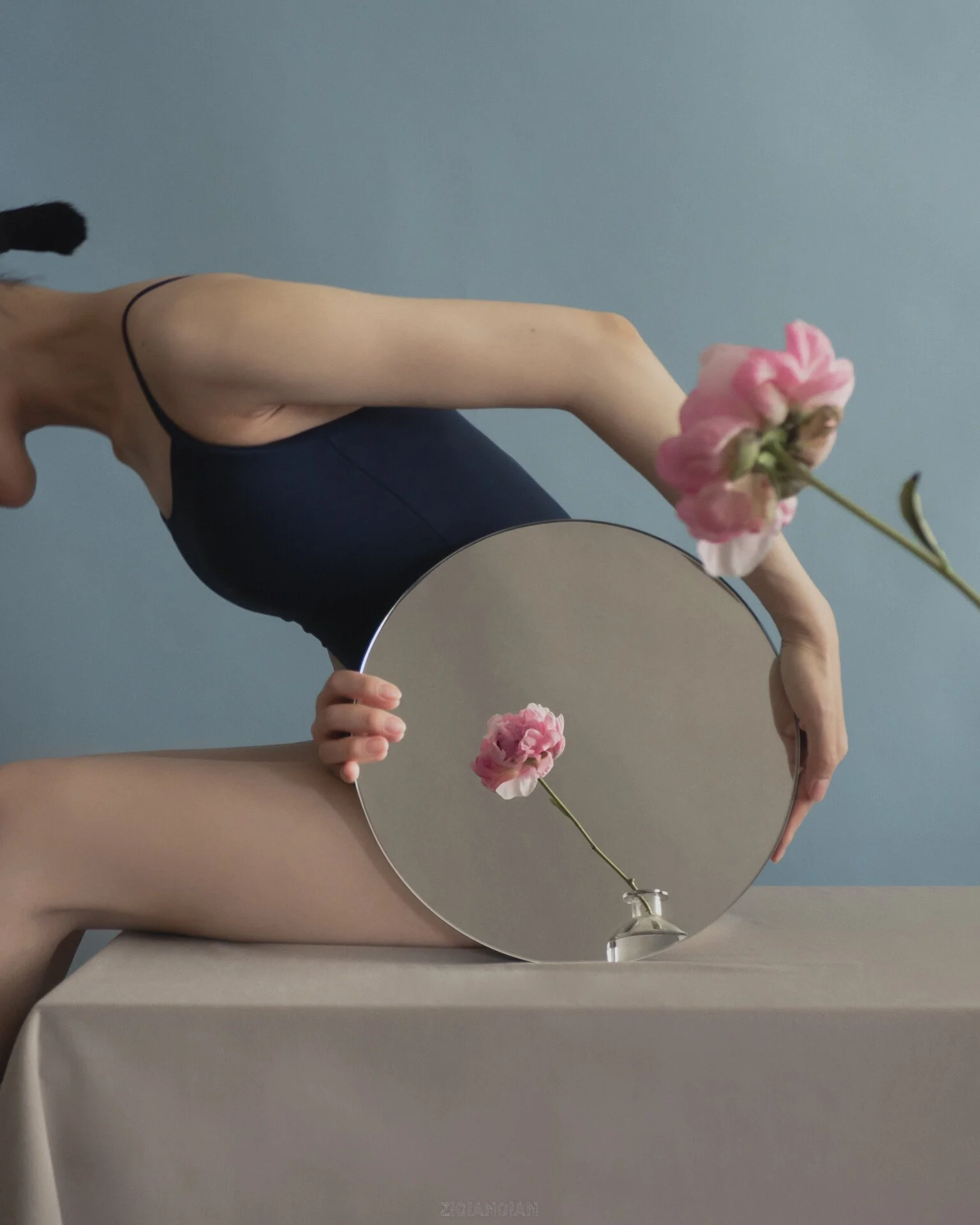
This is why certain self-portraits resonate so deeply. In the mirrored compositions of Shanghai-based artist Ziqian Liu, the figure is rarely frontal and the face often disappears. What remains are angles, shadows, curvature, posture, the geometry of a living form arranged among sparse botanicals. The effect is contemplative rather than conspicuous
In doing so, it raises a question: What do you see when you are not performing? When the ego relaxes, form is revealed, the architecture beneath personality, the design beneath display. The slope of a shoulder, the line of a spine, the rhythm of breath come into focus.
Viewed this way, the human figure is no longer something to evaluate but something to ponder. It carries time, change, strength, softness, and the visible evidence of living. Lingering before your own image without an agenda is often mistaken for vanity. It is not. Vanity seeks approval. Self-examination seeks understanding.
Unlike the myth of Narcissus, this practice is not a surface-level fixation. It is a willingness to remain present long enough to notice evolution. The glass becomes a witness to subtle shifts: posture evolving, vitality adapting, skin illustrating the passage of time. It allows admiration without denial and acceptance without resignation.
Oscar Wilde once suggested that one should either be a work of art or wear one. The deeper implication is more intimate: you already are one, though you may not have paused long enough to recognize it.
Portraiture and reflection share the same impulse to hold a moment still so it can be observed. Standing before yourself with reverence rather than judgment becomes an act of devotion. It acknowledges that who you are, in all its complexity, deserves attention.
Images are more than aesthetic arrangements; they often embody a way of seeing. Beauty is not spectacle but perception. Self-regard is not indulgence but integrity. The mirror does not merely reveal appearance. It reveals how willing you are to look. And to see yourself clearly is one of the most refined acts of self-love.
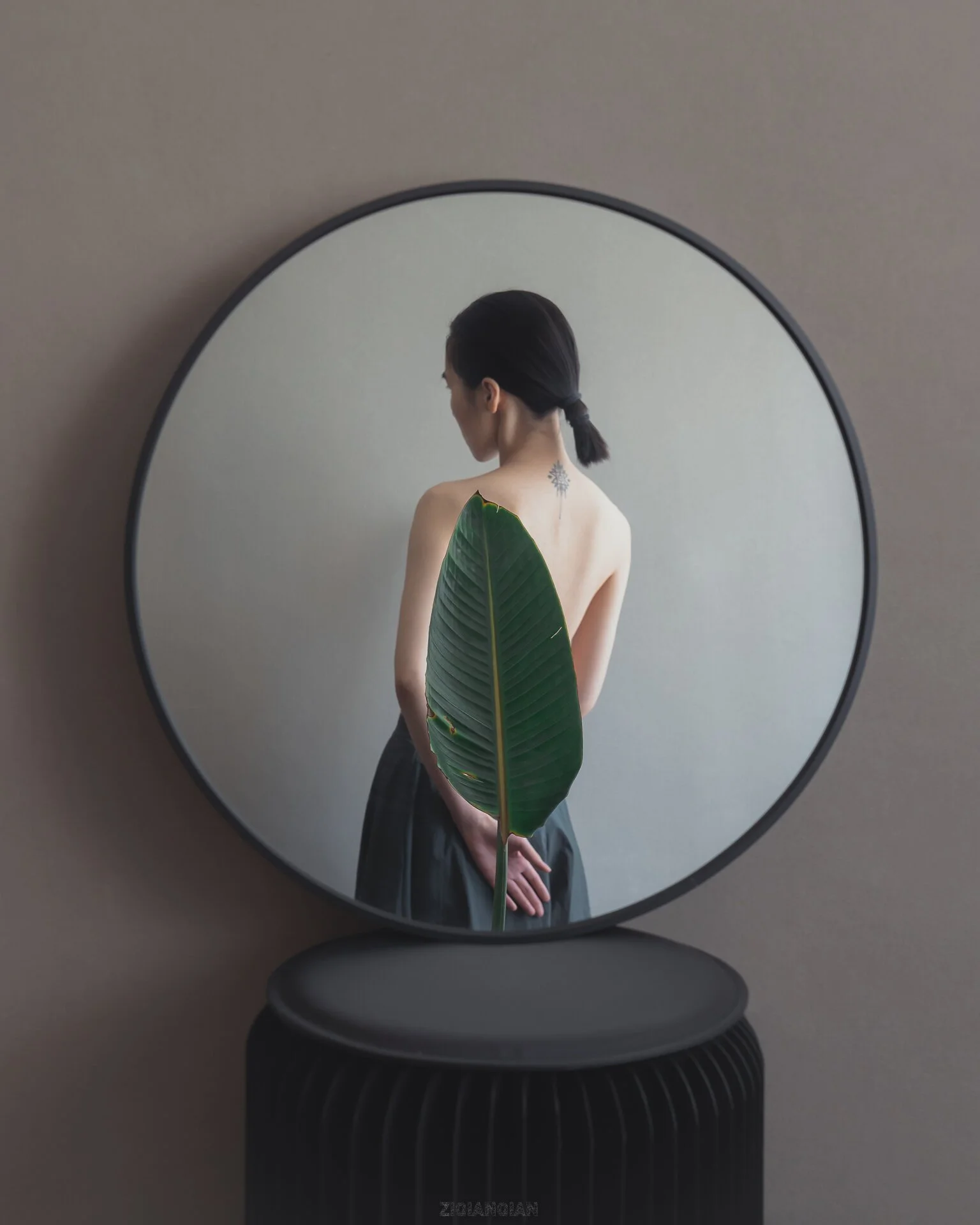
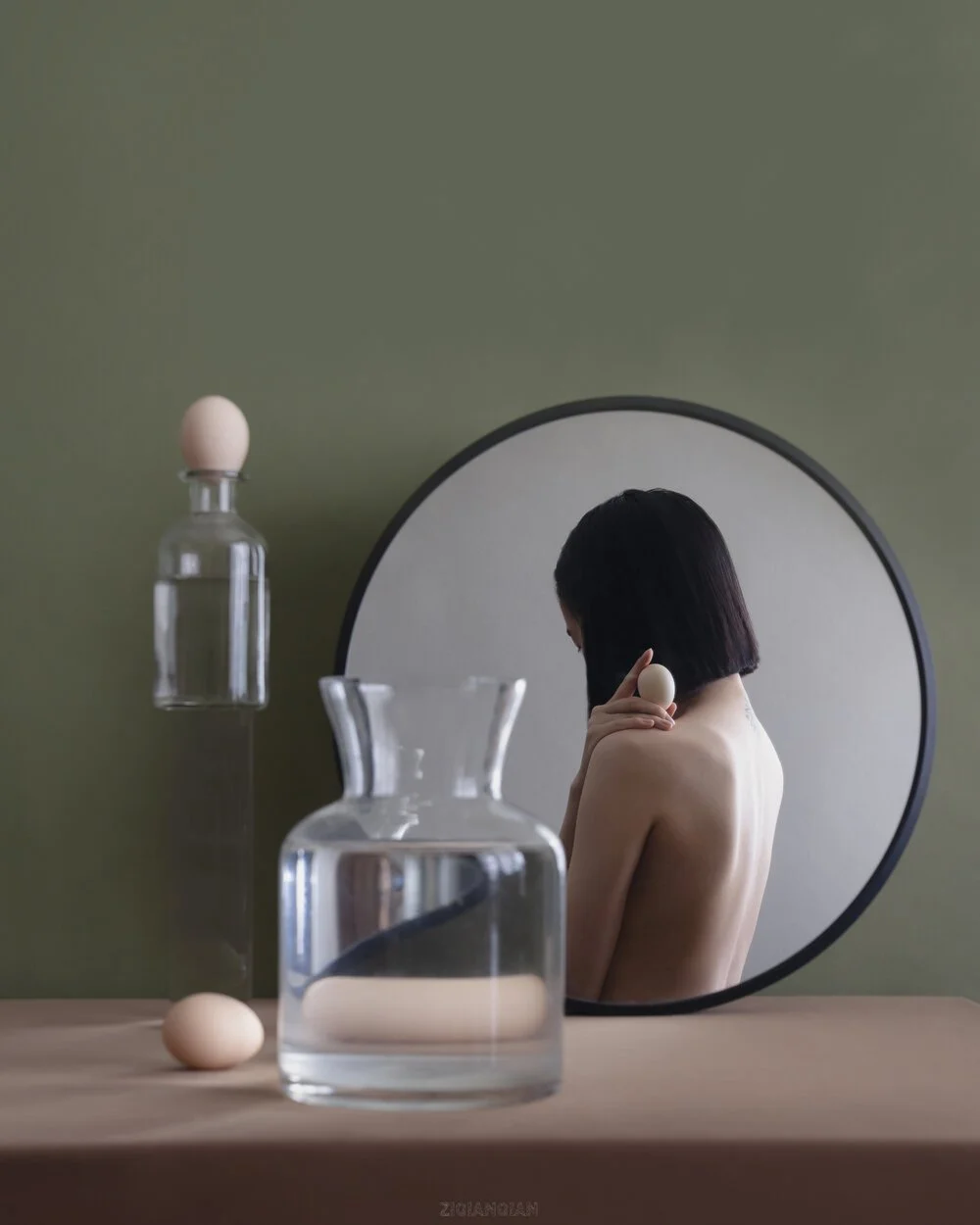
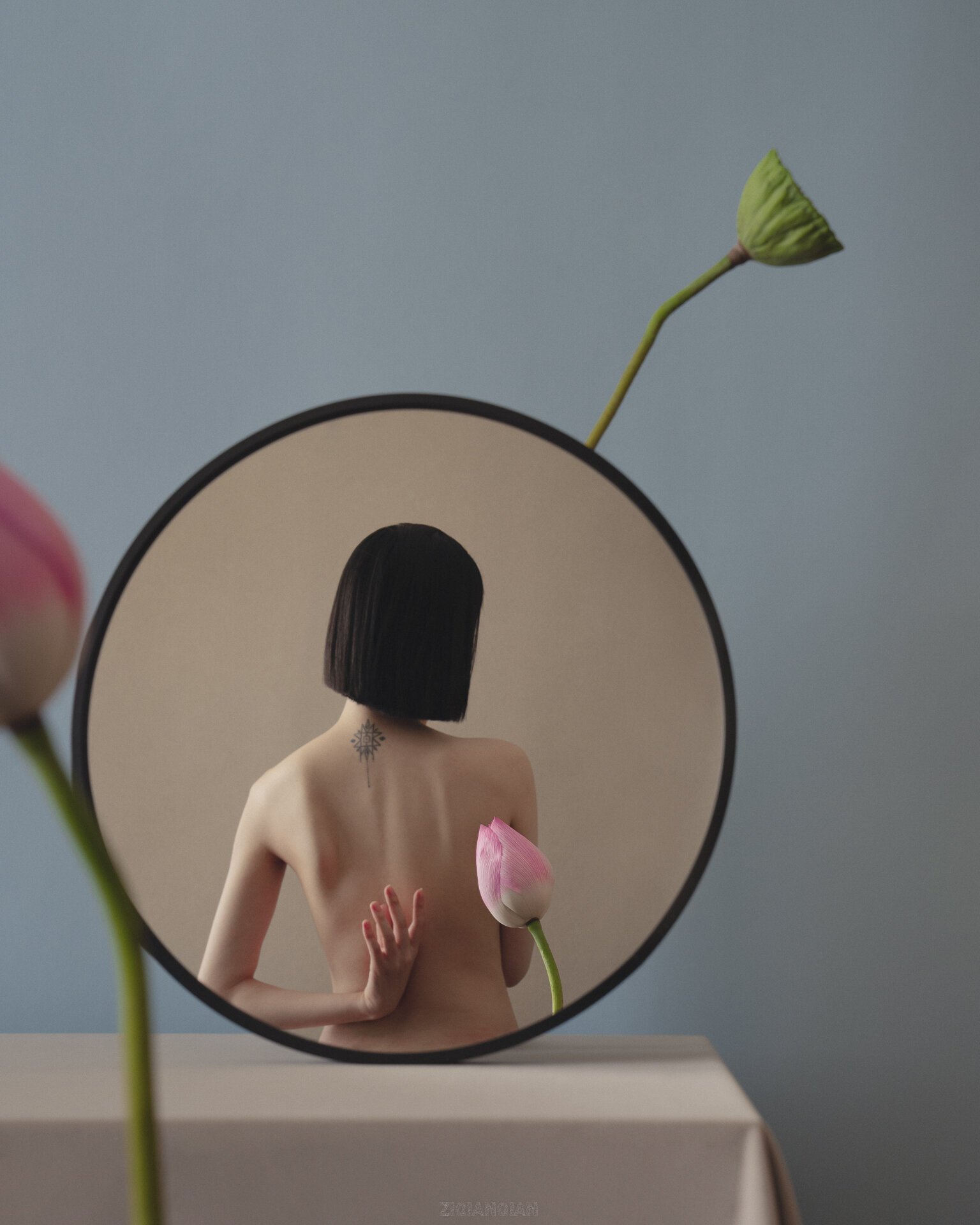
Reflections
When I look at myself without adjusting or correcting, what do I notice first? What do I tend to avoid noticing?
In what ways do I perform for my own reflection? What shifts when I allow the performance to fall away?
If my body were a portrait rather than a problem to solve, how would I describe its composition today?
What evidence of time, growth, or adaptation can I observe in my posture, expression, or carriage? How do I respond to those signs?
When I see myself clearly, without distortion or denial, what becomes easier in my daily life?
What would it mean to treat my reflection not as a surface to manage, but as a form to understand?
Resources
The Metamorphoses, The myth of Narcissus (Book III)—Ovid
The foundational literary account of Narcissus gazing into the reflective pool. Ovid’s version is not merely about vanity but about misrecognition — the inability to distinguish image from self. It offers a powerful counterpoint to the mirror as self-knowledge rather than self-absorption.
Ways of Seeing—John Berger
A seminal text on visual perception and representation. Berger examines how we are conditioned to see bodies — especially through art history and media. Essential for understanding how external gazes shape internal self-perception.
The Mirror Stage as Formative of the I Function—Jacques Lacan
Lacan’s psychoanalytic theory proposes that identity begins with recognizing oneself in a mirror. Though theoretical, it offers a rigorous framework for thinking about ego, image, and the formation of selfhood.
On Photography—Susan Sontag
While focused on photography, Sontag’s essays probe what it means to frame, capture, and consume images. Her insights translate powerfully to self-portraiture and the ethics of looking.
Self and Identity—Richard Jenkins
A sociological examination of how identity is formed through recognition — both internal and external. Useful for distinguishing between ego performance and authentic self-recognition.
